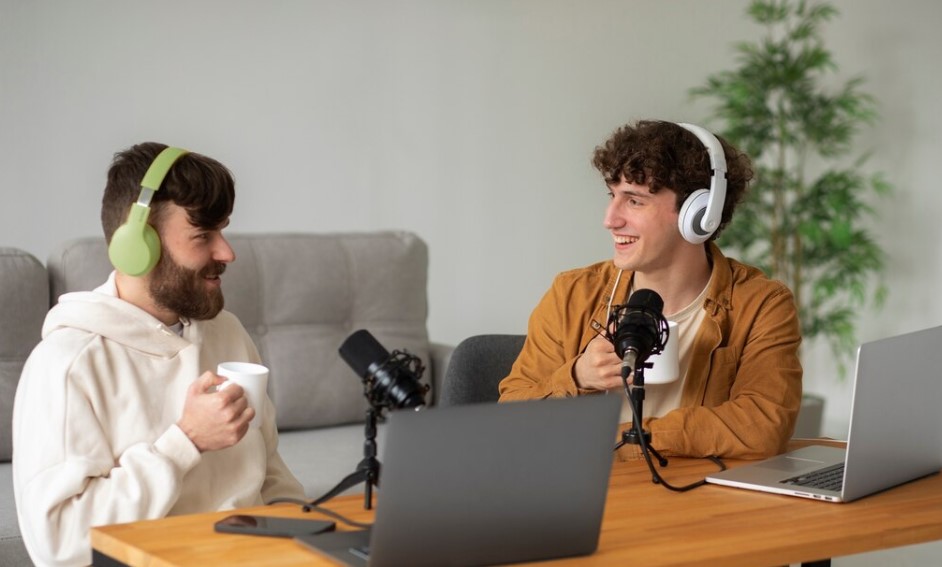
There is something that happens when you put on headphones and close your eyes to listen to a story. The world you're sitting in dissolves, gradually and then all at once, and the world being described in your ears becomes the only world that exists. It has happened with radio dramas, with audiobooks, with podcasts — and it happens now, with increasing frequency, with AI-generated audio fiction.
The question isn't whether AI can produce stories. That question has been answered, if imperfectly, by a generation of large language models that can generate prose in any style, on any topic, for indefinite lengths. The more interesting question — and the one the audio fiction industry is beginning to wrestle with — is what happens when AI-generated stories are specifically tuned for the person listening to them.
Why Audio Is the Right Medium
Before exploring what personalisation means for fiction, it's worth pausing on the format itself. Audio has had an extraordinary decade. The podcast industry grew from a niche interest to a mainstream cultural presence. Audiobook sales have consistently outpaced physical book sales in growth terms. And in the UK particularly, commuting culture — combined with the proliferation of affordable earbuds — has turned the ears of millions into a primary channel for long-form content.
But audio fiction sits in an interesting space between these forms. It's more immersive than a podcast in the way that a novel is more immersive than a magazine article. It's more intimate than a film score. And critically, it's the format where narration — the voice, the pace, the breath — does the most work. A story that reads adequately on the page can become something genuinely transporting when read aloud by a voice calibrated to its emotional architecture.
What Personalisation Actually Means
When people first encounter the phrase "personalised fiction," a reasonable instinct is scepticism. It sounds like a marketing term — the kind that gets applied to Netflix's recommendation algorithm, which surfaces shows you might enjoy but doesn't change the content of those shows based on who you are.
True personalisation in fiction is something more substantial. It means that the story's architecture — the characters, the setting texture, the emotional register, the pacing, the type of danger or romance or wonder that fills the narrative — shifts in response to what you bring to the experience. It doesn't mean the story becomes a fantasy about you specifically. It means the story becomes the kind of story you're most likely to find absorbing.
For audio fiction specifically, this matters in ways that text-based personalisation doesn't quite capture. Reading speed is self-regulated; listening pace is not. When a story is narrated, the narrator's choices — when to slow down, when to build, when to let silence sit — are embedded in the production. A story told by an intimate, unhurried voice lands differently from the same story told by a narrator with cinematic width and scale. Matching the narrator to the story, and the story to the listener's preferences, creates a cohesion that transforms the experience.
The Technical Challenge
Generating a story that feels genuinely personalised — rather than superficially customised — is a harder problem than it might appear. Early experiments in AI fiction generation produced output that was recognisably "generated": structurally coherent but emotionally flat, filled with correct prose moves but lacking the kind of specific, surprising detail that makes fiction feel real.
The advances that have made personalised audio fiction viable are threefold. First, the underlying language models have improved dramatically in their ability to sustain tone, character consistency, and narrative coherence over long-form output. A model that could write a compelling paragraph in 2021 can now write a compelling chapter in 2026.
Second, editorial frameworks — built and maintained by human writers — have become better at shaping and constraining generation in ways that produce quality outputs consistently. The model doesn't just generate freely; it generates within a scaffolding of craft principles that have been developed by people who understand how stories work.
Third, voice synthesis has reached a level of quality where the distinction between synthesised and recorded narration is no longer obvious on casual listening. More importantly, the synthesis can now adapt — adjusting intonation and pacing based on the emotional content of each passage rather than applying a single voice profile uniformly across different types of scenes.
The Listening Experience Changes the Story
There's a dimension of personalised audio fiction that rarely gets discussed in technical terms but matters enormously in practice: the listener's state.
People don't listen to stories in identical conditions. Someone commuting on a crowded tube at 8am is in a different psychological state from someone lying in a dark room at 11pm. The ambient energy is different. The degree of attention is different. The emotional openness is different. Personalised fiction systems that can factor in not just user preferences but the context of the listening session — time of day, selected mood, chosen intensity level — can shape the listening experience in ways that feel genuinely attentive rather than mechanically determined.
"The most powerful version of fiction is one that feels like it was made for the person reading it. Not because it reflects their biography, but because it reflects their imagination." — Daniel Ashworth, Creative Director, Novels AI
Where the Format Is Heading
The next phase of development in personalised audio fiction is likely to involve three areas. The first is deeper interactivity — not just decision points that branch the narrative, but ongoing responsiveness to how the listener is engaging, whether they've replayed sections, skipped ahead, or paused at particular moments.
The second is collaborative world-building. Rather than selecting from a menu of settings, future users may be able to describe the kind of world they want and have the generation system build it — developing its geography, history, and social texture before the story proper begins.
The third is community. Personalised fiction has traditionally been a solitary experience, but the communities gathering around audio fiction platforms suggest an appetite for shared engagement. The challenge is finding ways to build communal experience around content that is, by definition, individual.
A Format Worth Taking Seriously
There is a tendency in discussions of AI-generated creative content to treat the product as inherently inferior to human-made equivalents — a reasonable instinct, but one that doesn't quite account for how the field has developed. The question is no longer whether AI can produce competent fiction. It's whether AI-assisted fiction, when built with genuine editorial rigour and designed around the listener's experience, can offer something that existing formats don't.
The evidence from early adopters of personalised audio fiction suggests that it can. Not because it replaces literature — it doesn't — but because it offers something literature can't: a story that is, in a real and meaningful sense, yours.
That's not a small thing. Stories are how we understand ourselves and one another. A format that makes that experience more personal, more immediate, and more your own is worth paying attention to.